Schilling Medisystem Hudson Brace Set of 7 — Orthopedic Instrument Set with Brace, Extension, Perforator & Burrs
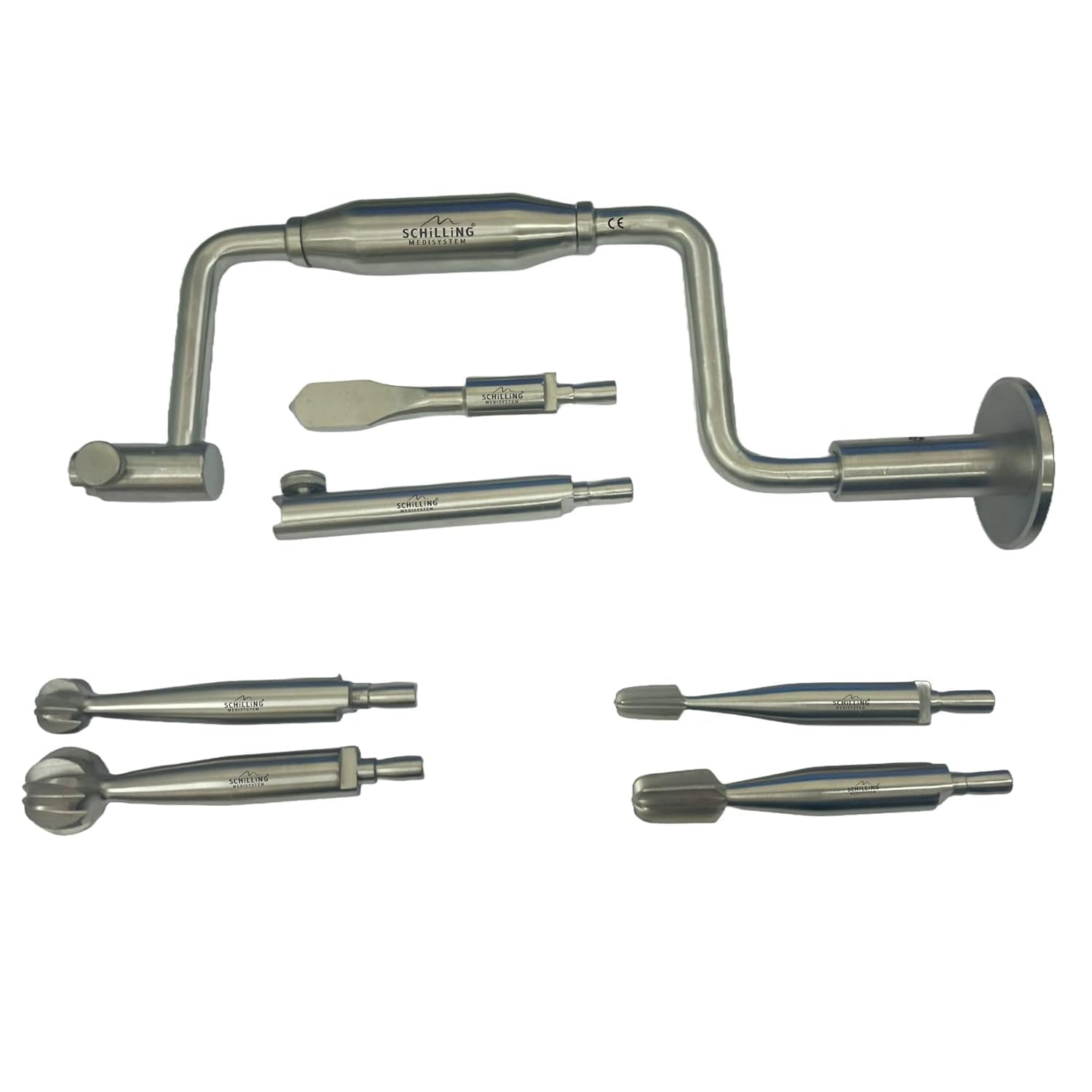
Schilling Medisystem Hudson Brace Set of 7 — Orthopedic Surgical Instrument Set
Short summary:
The Schilling Medisystem Hudson Brace Set of 7 is a comprehensive orthopedic instrument kit centered on a manual Hudson brace and its accessories — including extensions, a perforator, and four surgical burrs. Designed for precise bone work and controlled manual drilling, this set is suited for small orthopedic procedures, trauma reduction work, and surgical teaching environments.
This article explains what’s included, how it works, and where it fits into practice workflows.
Why a Hudson Brace Set Still Matters
Orthopedic surgery often requires controlled manual access to bone and dense tissue. While modern powered drivers and drills dominate large-scale OR workflows, manual brace systems retain several practical advantages:
- Fine manual control during delicate positioning
- Reduced reliance on power sources in low-resource settings
- Low noise, minimal vibration compared with powered tools
- Teaching value in surgical training environments
The Hudson brace and accessory burr system offer precise tactile feedback, which is particularly useful in settings where delicate bone perforation or controlled entry is required (e.g., pediatric orthopedics, small trauma interventions).
What’s Included in the Set
The Hudson Brace Set typically includes:
-
Hudson Brace (Handle)
- Main cranked handle for manual rotation
- Ergonomic grip for controlled torque
-
Extension Bar
- Allows deeper access into surgical fields
- Enhances reach while maintaining stability
-
Perforator Bit
- Used to create pilot perforations in cortical bone
- Often the initial entry point for further drilling
-
Four Surgical Burrs
- Various burr shapes and sizes for bone removal, contouring, and widening
- Provide options depending on surgical need
These components are typically supplied in a dedicated tray or case for organised storage and sterilisation.
Clinical Applications & Use Scenarios
Controlled Bone Perforation
The set enables precise pilot perforation in bone without over-penetration — a crucial step in:
- Pin or K-wire placement
- Small fragment fixation
- Biopsy tract creation
Manual perforation gives surgeons a direct feel of bone density and resistance, enhancing safety.
Debridement & Contouring
The included burrs allow for:
- Careful removal of bony spicules
- Debridement during trauma repair
- Gentle contouring around anatomical landmarks
This is useful when powered burrs may be too aggressive or not available.
Teaching & Training Environments
In teaching hospitals and skill labs, manual instruments reinforce core surgical mechanics, improving tactile understanding before transitioning to powered systems.
How It Works — Technique Overview
-
Position the Hudson Brace:
Identify the target site for perforation or contouring. -
Use the Perforator:
Apply steady, controlled rotation to create a pilot perforation. -
Choose an Appropriate Burr:
Select a burr based on size and region — smaller for fine work, larger for broader shaping. -
Operate with Manual Control:
Adjust hand pressure and rotation speed to match bone resistance, using tactile feedback to avoid cortical breach.
This technique emphasises controlled motion and tactile awareness, which can be preferable in delicate bone work.
Practical Pros & Limitations (Clinician-Focused)
Pros
- Manual control — tactile feedback and precision
- No dependency on power — useful in low-resource or field settings
- Multiple burr options — adaptable to small bone work
- Lightweight and transportable — suitable for outreach clinics
- Valuable teaching instrument for surgical training
Cons / Limitations
- Slower than powered drills for large procedures
- Not ideal for high-volume cortical work
- Requires manual dexterity and experience
- Burr selection is limited compared with larger powered sets
Typical Clinical Use Cases
- Small trauma interventions — pilot hole creation
- Orthopedic teaching labs — skill development
- Pediatric orthopedics — gentle manual control
- Outreach or low-resource environments — power-free operation
Buying Checklist (Before Recommending or Purchasing)
Before buying, confirm:
- Material quality of the brace and burrs
- Fit and feel of the Hudson brace handle
- Dimension compatibility of burrs and extensions
- Availability of spare burrs and accessories
- Sterilisation compatibility with your facility’s practices
These checks ensure that the set will integrate smoothly into your surgical workflows.
Where to Buy
View Schilling Medisystem Hudson Brace Set of 7 price on Amazon
Final Clinical Perspective
Manual orthopedic instrument sets like the Hudson Brace Set remain relevant for procedures where controlled tactile feedback and power-free operation are desirable.
While not a replacement for powered orthopedic drills in high-volume, high-density applications, this set supports:
- Delicate bone access
- Teaching environments
- Low-resource OR setups
- Complementary use alongside powered instruments
Appropriate application and familiarity with manual techniques can enhance surgical control and safety in selected procedures.
Affiliate Disclosure:
As an Amazon Associate, we earn from qualifying purchases. This supports our work in providing medical-technology comparisons. Product images used in this article are sourced from Amazon product listings for illustrative purposes.
Medical Disclaimer:
This article is intended for informational purposes only and does not replace professional surgical training or clinical judgment. Always follow institutional protocols and manufacturer instructions when using orthopedic instruments.