Precision and Care: The Safest Modern Tools for Tooth Extraction
Precision and Care: The Safest Modern Tools for Tooth Extraction
In 2026, the goal of dental surgery has shifted from simple “removal” to atraumatic preservation.
For dental professionals, extraction safety is measured by how well the alveolar bone and gingival tissue are protected—ensuring faster recovery and a stronger foundation for future implants.
Whether you are a seasoned practitioner or a dental student, mastering the safest extraction methods requires clinical patience, anatomical understanding, and high-quality instrumentation.
1. The Safest Approach: The Atraumatic Technique
Modern dentistry favors the “Wedge and Expand” philosophy over the outdated “Pull and Twist” method.
The objective is to reduce force by strategically loosening the tooth before forceps are applied.
Step-by-Step Safety Protocol
Step 1: Syndesmotomy (Ligament Release)
Use a fine periosteal elevator to sever the periodontal ligament (PDL) fibers around the cervical region of the tooth.
This reduces gingival resistance and the “suction” effect.
Step 2: Luxation (Socket Expansion)
Using elevators, apply gentle, controlled apical pressure (toward the root).
This expands the bony socket and creates micro-spaces between the tooth and surrounding bone.
Step 3: Controlled Forceps Application
Apply forceps only after initial mobility is achieved.
Seat the beaks as deep as possible beneath the gingival margin to grasp the root—not the crown—minimizing fracture risk.
2. Essential Instrumentation: The All-in-One Professional Solution
A safe extraction is impossible without an anatomically correct instrument for the specific tooth.
Using universal forceps for complex molars significantly increases the risk of root fracture and alveolar bone damage.
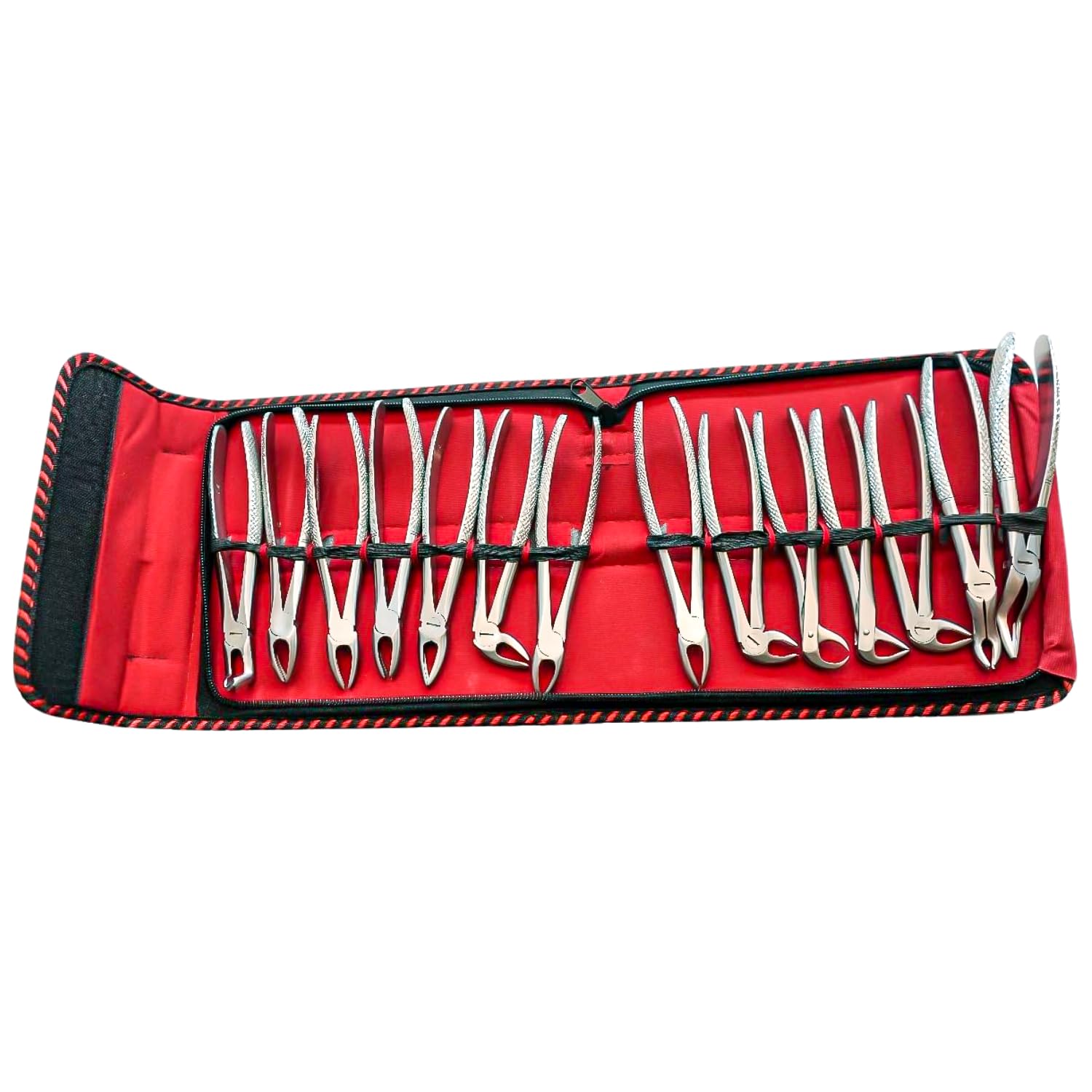
That’s why most clinicians rely on a 14-Piece Stainless Steel Tooth Extraction Forceps Set
Why This Set Is a Clinical Essential
-
Comprehensive Variety
Includes specialized patterns for upper & lower molars, premolars, incisors, and roots—no compromises during surgery. -
Precision Grip
Knurled handles ensure a non-slip grip, even with gloves, enabling delicate wrist-only movements. -
Surgical-Grade Stainless Steel
Corrosion-resistant, fully autoclavable, and built for repeated sterilization cycles. -
Anatomical Accuracy
Beaks are contoured to match root morphology, maximizing contact area and evenly distributing force to prevent root tip fractures.
View the 14-Piece Professional Extraction Set on Amazon
3. Safe Extraction Protocols by Tooth Type
| Tooth Type | Safety Motion | Recommended Tool |
|---|---|---|
| Maxillary Incisors | Rotation & slow labial movement | Straight anterior forceps |
| Mandibular Molars | Figure-of-8 (buccolingual) motion | Cowhorn / lower molar forceps |
| Premolars | Rotational & occlusal movement | Universal bicuspid forceps |
| Fractured Roots | Direct apical pressure | Fine-tipped root forceps |
4. Post-Extraction Safety: The “Golden Rules”
Extraction safety extends well into post-operative care. To protect the patient:
-
Hemostasis
Instruct the patient to bite on firm, damp gauze for 30–60 minutes. -
Socket Preservation
Avoid aggressive curettage unless infection is present. Preserving the natural blood clot is critical to preventing dry socket. -
Patient Education
No straws, smoking, or vigorous rinsing for at least 24 hours.
Final Verdict
A safe tooth extraction is a balance of clinical restraint and the right hardware.
By investing in a comprehensive 14-piece extraction forceps set, you eliminate the need to “make do” with sub-optimal tools—reducing complications, preserving anatomy, and strengthening patient confidence in your practice.
Affiliate Disclosure:
As an Amazon Associate, we earn from qualifying purchases. This helps us provide technical surgical guides for the dental community. Product images used in this article are sourced from Amazon product listings for illustrative purposes.
Medical Disclaimer:
This content is for professional educational purposes only. Dental extractions must be performed by trained professionals using appropriate clinical judgment.